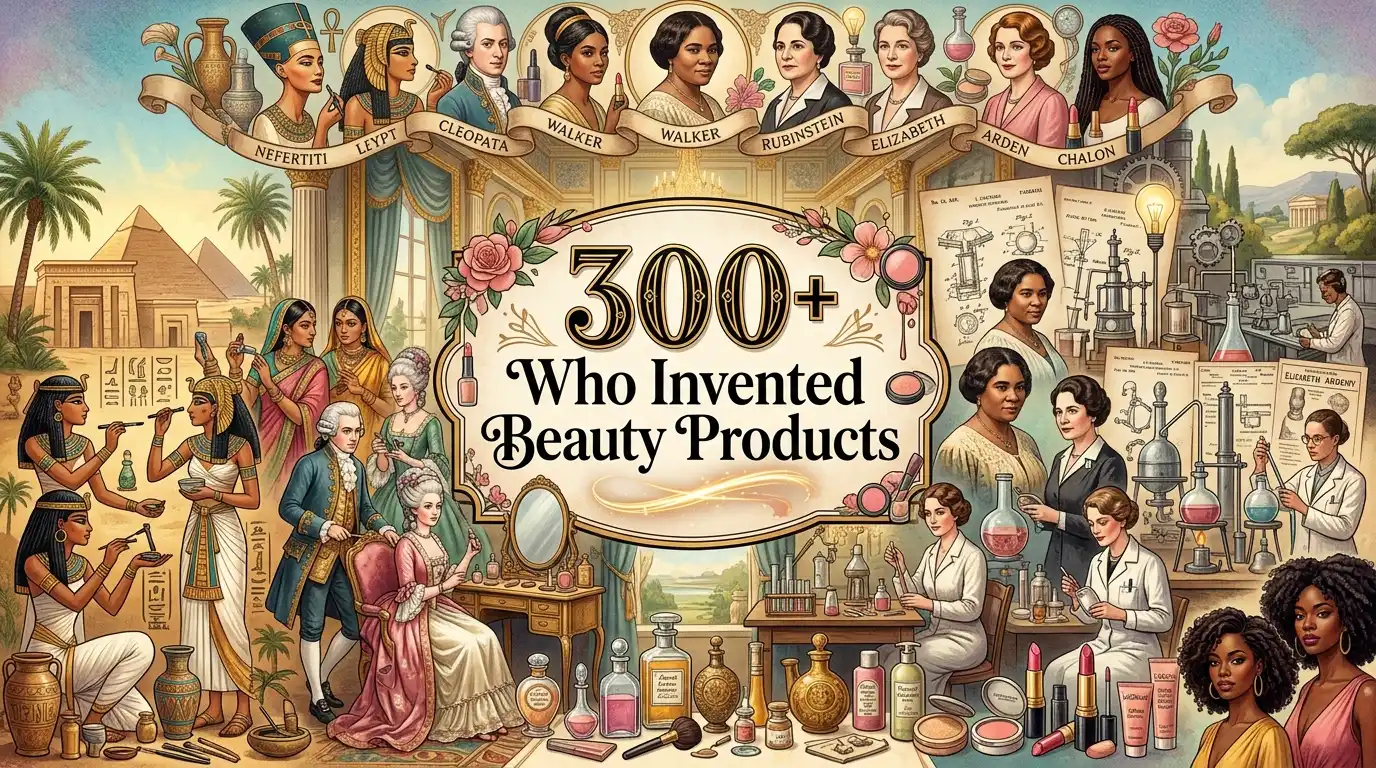
Beauty products feel modern, but the desire to care for the skin, enhance appearance, add color, and create a personal sense of confidence is thousands of years old. From mineral pigments and plant oils to modern moisturizers, lipstick, sunscreen, and advanced skincare, beauty has evolved alongside human culture.
So, who invented beauty products? The surprising answer is that no single person invented cosmetics. Ancient civilizations developed different forms of beauty products independently, using materials available in their environments. Over centuries, these traditions evolved into the cosmetics and personal-care industry we know today.
The history of beauty products is also a story about self-care, culture, science, creativity, status, identity, and wellness. People used cosmetics for celebrations, rituals, social occasions, personal grooming, and sometimes practical protection.
Understanding this history can also help modern shoppers make better choices. Today’s products may contain carefully formulated ingredients such as glycerin, ceramides, hyaluronic acid, antioxidants, pigments, oils, and UV filters, but the basic idea remains familiar: people have always looked for ways to care for themselves and express how they want to look.
Featured Snippet: Who Invented Beauty Products?
No single person invented beauty products. Cosmetics developed gradually across ancient civilizations, including Egypt, Mesopotamia, Greece, Rome, India, China, and other cultures. People used minerals, plants, oils, pigments, fragrances, and other natural materials for grooming, decoration, rituals, and skincare. Modern cosmetics later developed through science, manufacturing, and commercial beauty brands.
The Ancient Origins of Beauty Products and Cosmetics
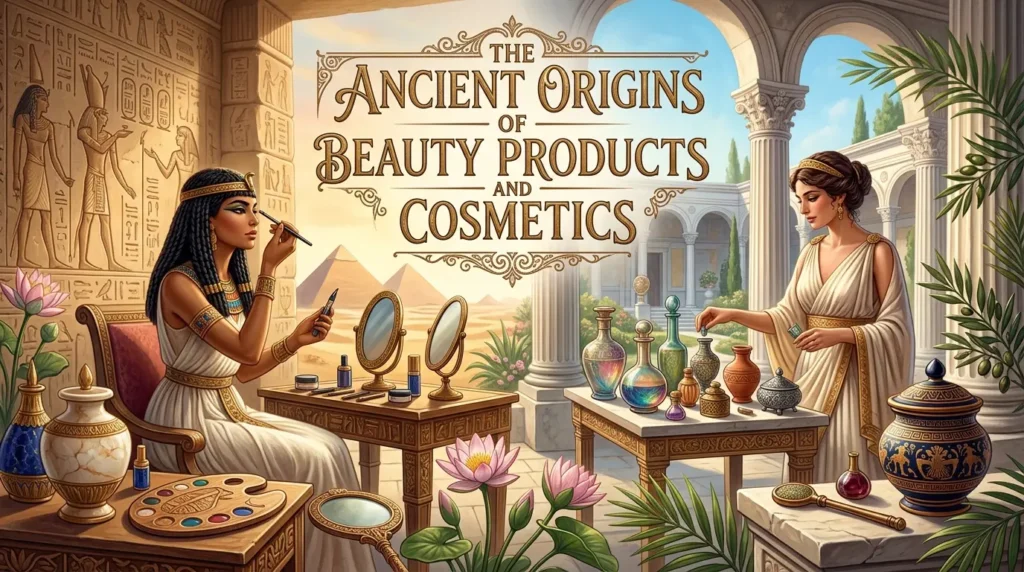
The history of cosmetics does not begin with a famous inventor. It begins with ordinary people experimenting with materials found in nature.
Ancient communities discovered that minerals could create color, oils could soften skin, aromatic plants could produce pleasant scents, and certain clays or powders could be used for cleansing or decoration.
This is why asking who invented makeup has a complicated answer. Different cultures developed different cosmetic practices at different times.
The U.S. Food and Drug Administration notes that naturally occurring color additives from vegetable and mineral sources were used for foods, drugs, and cosmetics in ancient times. It also notes that early Egyptians used artificial colors in cosmetics and hair dyes.
Why ancient beauty products mattered
Beauty products were not always created simply for vanity.
They could serve several purposes:
- Personal grooming.
- Cultural expression.
- Religious or ceremonial practices.
- Social status.
- Decoration.
- Fragrance.
- Skin conditioning.
- Hair coloring.
- Eye decoration.
For a modern example, imagine someone choosing a moisturizer because dry skin feels uncomfortable. An ancient person might have used an oil or plant-based preparation for a similar practical reason.
The ingredients were different, but the underlying desire for comfort and personal care was surprisingly similar.
Beginner tip: Think of ancient cosmetics as early forms of personal-care technology rather than comparing them directly with today’s laboratory-formulated products.
Important warning: Natural does not automatically mean safe. Some historical cosmetic ingredients were harmful, including substances containing lead or other toxic materials.
Ancient Egypt and the Development of Makeup and Skincare
When people search for who invented makeup, ancient Egypt is often one of the first civilizations mentioned.
Egyptian cosmetic practices became especially well known for eye makeup, pigments, oils, fragrances, and hair-related preparations.
Kohl-like eye cosmetics were used in parts of the ancient world, and Egyptian cosmetic traditions included mineral and other pigments.
The FDA specifically records that early Egyptians used artificial colors in cosmetics and hair dyes.
What did Egyptians use?
Historical cosmetic preparations could involve materials such as:
- Mineral pigments.
- Plant-based substances.
- Oils.
- Fragrant ingredients.
- Hair dyes.
- Eye cosmetics.
Cosmetics also carried social and cultural meaning.
Eye decoration was not simply a modern-style makeup trend. Beauty, identity, ritual, and appearance were closely connected.
Skincare lessons from history
Ancient use of oils highlights an idea that remains relevant today: skin benefits from appropriate moisturization and barrier support.
However, modern skincare has a major advantage. Today’s products can be formulated and tested using modern scientific knowledge.
Best practice: Do not copy ancient cosmetic recipes simply because they are traditional.
Historical ingredients may have unknown concentrations, contamination risks, or safety concerns.
The FDA warns specifically about certain traditional kohl, kajal, surma, and similar eye-area products because some have contained high levels of lead and may be illegal for cosmetic use in the United States.
Safety tip: Anything applied near the eyes deserves extra caution.
Mesopotamia and Early Cosmetic Traditions
Mesopotamia, often described as one of the world’s earliest centers of civilization, also contributed to the long history of grooming and fragrance.
People in ancient Mesopotamian societies used scented materials, oils, pigments, and grooming preparations.
The important point is that beauty practices developed across multiple regions. There was no single laboratory, inventor, or civilization responsible for creating all cosmetics.
Why this matters
Modern beauty culture sometimes makes products appear as though they emerged suddenly.
In reality, cosmetic traditions developed gradually through experimentation.
A plant could be used for fragrance. A mineral could provide pigment. An oil could be used on skin or hair. Over generations, people could refine those practices.
Beginner lesson
When researching the history of cosmetics, avoid statements such as:
One person invented all beauty products.
That is historically inaccurate.
A more useful way to understand cosmetic history is to follow individual product categories.
For example:
Beauty categoryHistorical developmentEye makeupMineral and pigment traditionsFragranceAromatic plants, oils, resinsSkin preparationsOils, fats, botanical ingredientsHair colorPlant and mineral pigmentsLip colorNatural pigments and waxy materialsCleansingWater, clays, oils, plant materials
Frequently overlooked fact: Different cultures may have developed similar cosmetic ideas independently because humans everywhere encountered comparable needs for grooming and decoration.
Ancient Greece and Rome: Beauty, Oils, and Fragrance
Ancient Greek and Roman societies continued developing cosmetic traditions.
People used oils, fragrances, powders, pigments, and grooming preparations. Beauty practices could vary according to gender, class, fashion, age, and social expectations.
Fragrance became especially important because aromatic oils and preparations could be associated with bathing, grooming, ceremonies, and social life.
The role of oils
Oils have remained important throughout skincare history.
Modern skincare still uses oils and emollients because they can help improve the feel and softness of the skin.
However, modern formulation science allows manufacturers to combine oils with humectants, emulsifiers, preservatives, antioxidants, and other ingredients in controlled formulas.
Ancient versus modern skincare
Ancient approachModern approachNatural oilsFormulated moisturizersMineral pigmentsTested cosmetic colorantsPlant fragrancesFragrance compositionsTraditional preparationsStandardized formulasLimited safety informationModern safety requirements and testing
Common mistake: Assuming ancient beauty routines were automatically healthier.
Ancient people had impressive knowledge of natural materials, but they did not have today’s understanding of microbiology, toxicology, ingredient purity, or cosmetic regulation.
Professional recommendation: Appreciate historical beauty practices while using modern safety standards for today’s products.
India and Traditional Beauty Practices
India has a long and diverse history of personal-care traditions.
Traditional Indian beauty practices have included plant-based ingredients, oils, haircare preparations, bathing rituals, fragrance, and decorative cosmetics.
Ayurvedic traditions also influenced approaches to personal care and wellness, although traditional systems should not be confused with modern dermatological treatment.
The historical importance of Indian beauty practices demonstrates that cosmetics were never exclusively a European or American invention.
Hair and skin traditions
Oils have played a major role in traditional Indian haircare.
Many people still use hair oils today because they can improve lubrication and make hair feel softer or easier to manage.
However, a product suitable for one scalp or hair type may not suit another.
Beginner tip: When trying traditional ingredients, start with a simple product and patch-test when appropriate.
When to avoid: Avoid applying unfamiliar homemade mixtures to irritated or broken skin.
Modern lesson
Traditional beauty practices can inspire modern formulations, but scientific evaluation still matters.
A historical ingredient can be interesting without being automatically effective or safe for every person.
For persistent acne, dermatitis, scalp conditions, or other concerns, consult a qualified healthcare professional rather than relying entirely on traditional cosmetic remedies.
China and the History of Cosmetics and Personal Care
China also has a long history of grooming, fragrance, haircare, pigments, and decorative cosmetics.
Historical Chinese beauty practices included facial powders, hair styling, fragrance, and various forms of personal adornment.
Like other civilizations, Chinese communities developed cosmetic traditions using materials available to them.
This reinforces the central answer to who invented beauty products: many cultures contributed.
Why cosmetic history is global
Beauty products developed because people across societies wanted to:
- Look attractive.
- Feel comfortable.
- Express identity.
- Participate in social customs.
- Prepare for ceremonies.
- Care for hair and skin.
- Enjoy fragrance and decoration.
These motivations remain familiar today.
Someone applying lipstick before a celebration and someone historically applying decorative pigment before a ceremony may have very different products, but both demonstrate how appearance can connect with confidence and social expression.
Key fact: Modern beauty is the result of many historical traditions rather than one invention.
How Natural Ingredients Became Early Beauty Products
Before modern laboratories, people depended heavily on nature.
Plants, minerals, clays, oils, waxes, resins, and animal-derived materials could all become part of personal-care preparations.
Some ingredients provided color. Others provided scent or texture.
Common historical ingredient categories
Minerals: Used for pigments and decorative colors.
Plants: Used for fragrance, dyes, oils, and traditional preparations.
Oils: Used to condition skin and hair.
Waxes: Useful for texture and protective cosmetic preparations.
Resins: Often associated with fragrance.
The FDA confirms that vegetable and mineral sources were used historically as color additives in cosmetics and other products.
What changed?
The biggest change was not the discovery of beauty itself.
It was the development of controlled formulation.
Modern cosmetic scientists can measure ingredients, standardize batches, study stability, evaluate microbial contamination, and design specific textures.
Advanced tip: When evaluating a modern product, consider the entire formulation rather than focusing on whether one ingredient is natural or synthetic.
Myth: Natural ingredients are always better.
Fact: Safety and suitability depend on the ingredient, concentration, formulation, manufacturing process, and individual user.
The Evolution of Makeup, Skincare, and Fragrance
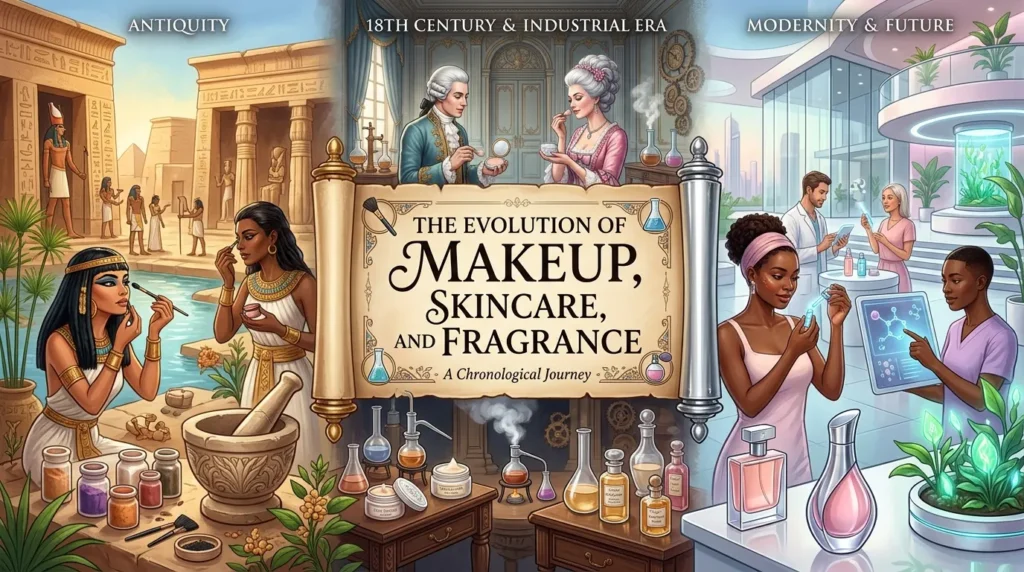
Cosmetics changed dramatically during the nineteenth and twentieth centuries.
Industrial manufacturing made beauty products easier to produce at scale.
Packaging also transformed the industry. Instead of preparing cosmetic mixtures at home, consumers could purchase standardized products.
Color technology played an important role.
The FDA notes that William Henry Perkin discovered the first synthetic organic dye, mauve, in 1856, after which similar synthetic dyes became increasingly used in foods, drugs, and cosmetics.
This development helped expand the range of available cosmetic colors.
The rise of modern categories
Modern consumers recognize categories such as:
- Foundation.
- Mascara.
- Lipstick.
- Blush.
- Moisturizer.
- Serum.
- Sunscreen.
- Shampoo.
- Conditioner.
- Fragrance.
- Nail polish.
These categories developed gradually rather than appearing all at once.
Benefits of modern formulation: Greater consistency, improved texture, specialized ingredients, and more standardized manufacturing.
Important warning: Historical cosmetic development also included dangerous products. The FDA documents early twentieth-century products containing toxic materials and describes serious injuries associated with some cosmetics.
That history explains why cosmetic safety and regulation matter.
Who Created Modern Cosmetics and the Beauty Industry
If ancient civilizations created early cosmetics, who created the modern beauty industry?
Again, there was no single inventor.
However, numerous entrepreneurs, chemists, manufacturers, artists, and business leaders helped shape modern cosmetics.
The nineteenth and twentieth centuries saw the growth of dedicated beauty companies, department-store cosmetics, salons, professional beauty services, advertising, and branded products.
The concept of a beauty brand changed shopping.
Consumers could identify products by company name, packaging, color, fragrance, and marketing.
What made modern beauty different?
Modern cosmetics became:
- Mass-produced.
- Packaged.
- Branded.
- Advertised.
- Sold through dedicated retail channels.
- Formulated for specific cosmetic effects.
This created the foundation for today’s enormous global beauty market.
Beginner takeaway: If someone asks who invented the beauty industry, the most accurate answer is that many entrepreneurs and manufacturers helped build it over time.
No single person can reasonably receive credit for the entire industry.
Helena Rubinstein, Elizabeth Arden, and Modern Beauty Entrepreneurship
The early twentieth century produced influential beauty entrepreneurs, including Helena Rubinstein and Elizabeth Arden.
They helped transform cosmetics and skincare into sophisticated consumer businesses.
Rather than inventing beauty products from nothing, entrepreneurs like these helped organize, brand, market, package, and commercialize beauty products for modern consumers.
This distinction matters.
A person may invent a specific formula without inventing an entire product category.
Why beauty entrepreneurs mattered
They helped popularize:
- Skincare routines.
- Branded cosmetics.
- Beauty salons.
- Specialized products.
- Consumer education.
- Premium beauty experiences.
Their business models influenced how people think about beauty today.
Modern lesson: Today’s beauty brands continue this tradition by combining formulation science with branding, storytelling, packaging, and consumer education.
Common mistake: Crediting one famous entrepreneur with inventing all modern cosmetics.
It is more accurate to say these entrepreneurs helped shape specific parts of the modern industry.
How Science Changed Skincare Ingredients and Cosmetic Formulas
Science changed beauty more profoundly than almost any individual inventor.
Modern cosmetic formulation involves chemistry, microbiology, dermatology, toxicology, packaging science, sensory testing, and manufacturing controls.
A modern moisturizer may contain multiple ingredient classes that work together.
Common modern skincare ingredient groups
Humectants such as glycerin help attract water.
Emollients help improve softness and smoothness.
Occlusive ingredients can help reduce water loss from the skin.
Ceramides are used in formulas designed to support the skin barrier.
Antioxidants are included in many products to help protect formulations or provide cosmetic skin benefits.
UV filters are used in sunscreens to reduce UV exposure when used correctly.
Why formulation matters
Two products can contain the same headline ingredient but perform differently.
The surrounding formula affects:
- Texture.
- Stability.
- Absorption.
- Sensory feel.
- Shelf life.
- Skin compatibility.
Professional tip: Do not judge a skincare product solely by its most advertised ingredient.
When to use active ingredients: Use products designed for your particular concern and follow the manufacturer’s instructions.
When to avoid experimentation: If your skin is already irritated, simplify your routine instead of adding multiple new actives.
The Rise of Mass-Market Makeup and Beauty Brands
The twentieth century transformed cosmetics from relatively specialized products into everyday consumer goods.
Advertising helped beauty brands reach larger audiences.
Department stores, pharmacies, salons, catalogs, television, magazines, and eventually the internet all changed how people discovered beauty products.
Makeup became increasingly connected with fashion and popular culture.
Skincare also became more specialized.
Instead of simply using cold cream or basic oils, consumers could choose products marketed for dryness, oiliness, aging appearance, cleansing, hydration, or other cosmetic concerns.
Today’s beauty shelf
A modern consumer might have access to:
- Cleansers.
- Toners.
- Serums.
- Moisturizers.
- Sunscreens.
- Eye creams.
- Masks.
- Makeup primers.
- Foundations.
- Concealers.
- Blushes.
- Lip products.
- Hair treatments.
This variety creates choice but also confusion.
Best practice: Build a routine around your needs rather than buying every available category.
Simple modern routine
Morning:
- Gentle cleanse if needed.
- Moisturizer.
- Broad-spectrum sunscreen.
- Makeup if desired.
Night:
- Remove makeup.
- Cleanse.
- Use appropriate treatment products.
- Moisturize.
A routine this simple can be more sustainable than a complicated ten-step regimen.
Beauty Product Safety, Ingredients, and Consumer Protection
The history of cosmetics also teaches an important lesson: beauty should never come at the expense of safety.
Early cosmetic products were not always evaluated with modern scientific methods.
The FDA notes that some color additives used historically included toxic substances such as lead, arsenic, and mercury.
The agency also documents how an eyelash dye called Lash Lure caused serious injuries, including vision impairment and blindness, helping demonstrate the need for stronger cosmetic oversight.
In the United States, the Federal Food, Drug, and Cosmetic Act of 1938 gave the FDA authority over cosmetics for the first time.
More recently, the Modernization of Cosmetics Regulation Act of 2022, or MoCRA, expanded FDA authority over cosmetics. The FDA describes it as the most significant expansion of its cosmetic regulatory authority since 1938.
Smart beauty safety checklist
- Read the label.
- Follow directions.
- Avoid contaminated products.
- Do not share eye makeup.
- Patch-test when appropriate.
- Stop using products that cause significant irritation.
- Buy from reputable sources.
- Keep products stored according to instructions.
Warning: Serious swelling, severe irritation, breathing difficulty, eye injury, or other significant symptoms require appropriate medical attention.
Cosmetics can support appearance and self-care, but they should not replace medical treatment.
Myths and Facts About Who Invented Cosmetics
Beauty history contains plenty of oversimplified claims.
Here are some of the most common.
MythFactOne person invented beauty products.Cosmetics developed across many cultures and centuries.Cleopatra invented makeup.Ancient Egyptian cosmetic traditions existed long before and beyond any single ruler.Makeup began in modern Europe.Cosmetic practices existed in many ancient civilizations.Natural cosmetics were always safe.Some historical ingredients were toxic.Modern cosmetics appeared suddenly.Modern products evolved from centuries of experimentation and manufacturing advances.One entrepreneur invented the beauty industry.Many people shaped modern beauty commerce.Ancient skincare was always better.Modern science provides advantages in formulation and safety evaluation.Expensive skincare is automatically superior.Price does not guarantee suitability or effectiveness.
The historical record supports a much broader story.
The FDA’s historical materials specifically identify ancient vegetable and mineral colorants and Egyptian cosmetic practices, reinforcing that cosmetic use predates modern commercial beauty companies by thousands of years.
Key fact: The history of beauty is collective.
How Beauty Products Continue to Evolve Today
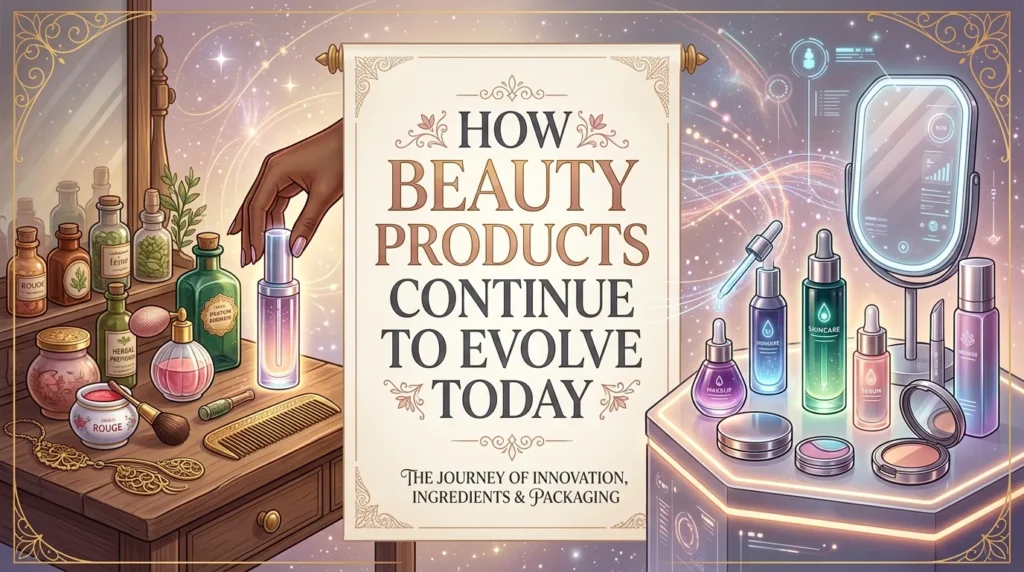
The beauty industry continues to change rapidly.
Modern consumers increasingly ask questions about ingredients, sustainability, skin compatibility, transparency, inclusivity, and evidence.
At the same time, technology is changing how products are developed and marketed.
Today’s trends include:
- Barrier-focused skincare.
- Gentle formulations.
- Multifunctional products.
- Personalized beauty.
- Ingredient transparency.
- Inclusive shade ranges.
- Scalp-focused care.
- Hybrid makeup-skincare products.
- At-home beauty technology.
- More informed consumer research.
Some trends are genuinely useful. Others are simply marketing cycles.
How to choose products intelligently
Ask five questions:
What problem am I trying to solve?
Is this product designed for that purpose?
Do the ingredients make sense for my skin or hair?
Can I use it safely according to the instructions?
Do I really need it?
This approach helps separate useful innovation from unnecessary shopping.
The future of beauty
The next generation of beauty products will likely continue combining cosmetic chemistry, biotechnology, consumer data, sustainability, and personalization.
But the basic purpose will remain familiar.
People will continue using beauty products to care for themselves, express identity, feel confident, and enjoy personal rituals.
That is why the question who invented beauty products has such an interesting answer.
Nobody invented beauty itself.
Human beings developed beauty practices together, across cultures and generations.
Conclusion
So, who invented beauty products? The most accurate answer is that no single individual invented them.
Ancient Egyptians, Mesopotamians, Greeks, Romans, Indians, Chinese communities, and many other cultures developed cosmetic and personal-care practices using the materials and knowledge available to them. Over centuries, these traditions evolved into modern makeup, skincare, haircare, fragrance, and personal-care products.
The modern beauty industry then grew through science, manufacturing, entrepreneurship, branding, retail, and improved consumer protection.
Today’s beauty products are far more sophisticated than ancient preparations. Modern formulations can contain carefully selected humectants, emollients, ceramides, antioxidants, pigments, preservatives, and UV filters, depending on their purpose.
Yet the central idea has not changed.
Beauty products can be part of self-care, confidence, creativity, grooming, and personal expression.
The best approach today is to enjoy beauty without feeling pressured to buy everything. Choose products according to your skin and hair needs, learn to read labels, practice good hygiene, and be cautious about exaggerated claims.
If you have persistent acne, severe irritation, unusual pigmentation, painful rashes, scalp problems, or another serious concern, consult a dermatologist instead of relying only on cosmetic products.
Beauty has thousands of years of history behind it. The healthiest future for beauty combines that creativity with modern science, responsible formulation, and informed choices.
FAQs
Who invented beauty products?
No single person invented beauty products. Different civilizations developed cosmetics and personal-care preparations independently over thousands of years.
Did Cleopatra invent makeup?
No. Cleopatra did not invent makeup. Cosmetic practices existed in ancient Egypt long before her lifetime.
Who invented modern cosmetics?
Modern cosmetics were developed gradually by chemists, manufacturers, entrepreneurs, and beauty professionals. No single person invented the entire modern cosmetics industry.
Were ancient beauty products safe?
Not always. Some historical cosmetic ingredients could be toxic. The FDA documents the historical use of harmful substances such as lead, arsenic, and mercury in certain products.
When did cosmetics become regulated in the United States?
The Federal Food, Drug, and Cosmetic Act of 1938 gave the FDA authority over cosmetics for the first time.
Why are beauty products important?
Beauty products can support grooming, self-expression, confidence, comfort, and personal-care routines. They should complement healthy habits rather than create unrealistic pressure.
How should beginners choose skincare products?
Start with basic products such as a gentle cleanser, moisturizer, and sunscreen. Add specialized treatments slowly and choose products based on your skin’s actual needs.