Introduction
Beauty is more than having clear-looking skin. It is also about feeling comfortable, confident, and cared for in your own skin. A thoughtful skincare routine can become a small daily wellness ritual, especially when you understand what goes into the products you use.
Paraben free beauty products have become increasingly popular among people who want simpler ingredient lists or prefer to avoid parabens. From cleansers and moisturizers to makeup, sunscreen, haircare, and body products, many brands now offer formulas labeled paraben-free.
However, choosing products based only on a front-label claim is not always enough. A good routine should consider your skin type, individual sensitivities, product formulation, preservation system, and the specific results you want.
This guide explains what paraben-free products are, how preservatives work, potential benefits and limitations, how to build a routine, and what to look for when shopping. The goal is not to fear ingredients but to help you make informed beauty choices.
Featured Snippet
Paraben free beauty products are cosmetics, skincare, haircare, or personal-care products formulated without parabens as their preservative ingredients. People may choose them because of personal preferences, ingredient sensitivities, or a desire for simpler formulas. However, paraben-free does not automatically mean safer, gentler, more natural, or better for every skin type.
Understanding Paraben Free Beauty Products and Clean Skincare Labels
Paraben free beauty products are formulated without parabens, a group of preservatives historically used in cosmetics, skincare, haircare, and personal-care formulas.
Preservatives have an important job. Products containing water can provide an environment where microorganisms such as bacteria, yeast, and mold may grow. A suitable preservation system helps keep the product stable and safe during normal use.
Common parabens include methylparaben, propylparaben, ethylparaben, and butylparaben. A product labeled paraben-free is generally made without these ingredients.
That does not mean the formula contains no preservatives. Instead, manufacturers may use alternative preservation systems.
Why people choose paraben-free products
Consumers may look for these formulas because of:
- Personal ingredient preferences.
- Previous reactions to particular cosmetic products.
- Interest in minimalist beauty routines.
- Preference for certain clean-beauty standards.
- Desire to avoid specific ingredients.
- Recommendations from a skincare professional.
A useful beginner rule is simple: read the complete ingredient list instead of relying only on the marketing claim on the front of the package.
Common mistake
Do not assume that paraben-free means preservative-free. A properly formulated water-based cosmetic usually needs protection against microbial contamination.
How Parabens Work in Cosmetics and Why Preservatives Matter
Parabens are preservatives. Their main purpose is to help prevent microbial growth and extend the usable life of certain cosmetic formulations.
Preservation becomes particularly important in products that contain water. Think about a facial cleanser, lotion, serum, or cream that you repeatedly open with your hands. Without an effective preservation system, contamination can become a serious formulation concern.
A paraben-free product therefore needs another suitable method of preservation.
What alternative preservatives may appear?
Depending on the formulation, you may see ingredients such as:
- Phenoxyethanol.
- Sodium benzoate.
- Potassium sorbate.
- Benzyl alcohol.
- Organic acids and their salts.
- Other preservation systems selected by the formulator.
The presence of an alternative preservative does not automatically make a product bad. Likewise, the absence of parabens does not automatically make a product superior.
Expert-informed perspective
Cosmetic safety depends on the entire formulation, concentration, manufacturing process, packaging, intended use, and preservation strategy.
For beginners, the most useful approach is to avoid judging a product by one ingredient alone.
Best practice: evaluate the complete formula and how your skin responds to it.
Benefits and Limitations of Paraben Free Skincare and Makeup
One potential advantage of paraben-free beauty products is that they allow consumers to follow a personal ingredient preference. They can also be useful for people who specifically want to avoid parabens because of a known sensitivity or professional recommendation.
However, it is important to separate reasonable preferences from exaggerated beauty claims.
Potential benefits
- Ingredient preference: You can choose formulas that match your personal standards.
- Routine simplicity: Many paraben-free products are marketed with straightforward ingredient profiles.
- More choices: The beauty market now offers many preservative alternatives.
- Personal comfort: Some consumers prefer products without particular ingredients.
- Targeted shopping: Ingredient labels make it easier to build a routine around specific preferences.
Important limitation
Paraben-free does not automatically mean hypoallergenic.
A person can react to fragrance, essential oils, botanical extracts, preservatives, dyes, or other ingredients.
Another common misconception is that removing parabens automatically improves skin health. There is no universal rule that every person will experience better skin simply because a product is paraben-free.
When it may be useful
Consider paraben-free products when:
- You have a personal preference for avoiding parabens.
- A dermatologist has advised you to avoid a particular ingredient.
- You are simplifying your product routine.
- You are carefully tracking ingredients after cosmetic reactions.
When to reconsider
If a paraben-free product causes redness, burning, itching, swelling, or persistent irritation, stop using it and consider professional advice.
Ingredients to Look for in Paraben Free Beauty Products
When shopping for paraben-free skincare, ingredient knowledge is more useful than simply memorizing brand names.
Start by identifying what your skin actually needs.
For dry skin, look for moisturizing ingredients such as glycerin, ceramides, hyaluronic acid, squalane, and fatty alcohols.
For oily or blemish-prone skin, lightweight formulas may be more comfortable. Ingredients such as niacinamide or salicylic acid may be useful for some people, depending on the formulation and individual tolerance.
For sensitive skin, simplicity can help. Look for products with fewer potential irritants and consider avoiding strong fragrance if you know it bothers your skin.
Ingredient checklist
Before buying, ask:
- Is the product clearly labeled?
- Does the ingredient list appear complete?
- Does the formula suit my skin type?
- Does it contain ingredients I already know irritate me?
- Is the packaging appropriate for the formula?
- Does the product have clear usage instructions?
Frequently overlooked tip
Do not automatically choose a product because it contains many popular ingredients. A long ingredient list is not necessarily better.
A simple formula that your skin tolerates well can be more useful than a complicated formula full of trendy ingredients.
Best Paraben Free Beauty Products for Different Skin Types
Your skin type should guide product selection more than a marketing label.
Dry skin
Choose creamy cleansers, barrier-supporting moisturizers, and products containing ceramides, glycerin, and emollients.
Avoid excessive cleansing and very hot water, which can leave dry skin feeling tighter.
Oily skin
Lightweight, non-greasy moisturizers and gentle cleansers may work well. Do not skip moisturizer simply because your skin produces oil.
Combination skin
You may need different approaches for different areas. A lighter moisturizer can feel comfortable on oily zones while richer hydration may help drier areas.
Sensitive skin
Prioritize a simple routine. Fragrance-free and gentle are often more relevant to comfort than the paraben-free claim alone.
Mature or dry-feeling skin
Focus on hydration, barrier support, and sun protection. Ingredients such as ceramides, glycerin, peptides, and retinoids may have a place depending on your goals and tolerance.
Beginner tip
Introduce one new product at a time. If you add five new products simultaneously and develop irritation, identifying the cause becomes much harder.
Building a Daily Paraben Free Skincare Routine for Healthy Skin
A good routine does not need to contain ten products.
A basic routine can include:
- Gentle cleanser.
- Targeted serum if needed.
- Moisturizer.
- Broad-spectrum sunscreen during the daytime.
This simple structure works as a starting point for many people.
Morning routine
Begin with gentle cleansing if needed. Follow with a suitable treatment product, moisturizer, and broad-spectrum SPF 30 or higher sunscreen.
Sunscreen remains one of the most important daily skincare habits because ultraviolet exposure contributes to premature skin aging and other skin concerns.
Night routine
At night, remove makeup and sunscreen thoroughly. Cleanse gently, apply any targeted treatment, and finish with moisturizer.
Practical example
If you have normal-to-dry skin, a simple routine might involve a gentle cleanser, hydrating serum, moisturizer, and sunscreen in the morning. At night, you could cleanse, use a suitable treatment on selected evenings, and moisturize.
Common mistake
More products do not automatically produce better skin.
Over-exfoliating, frequently switching products, or combining multiple strong treatments can increase irritation.
Morning, Night, Weekly, and Seasonal Paraben Free Beauty Routines
Your skin does not necessarily need the same routine every day of the year.
Morning
Focus on:
- Gentle cleansing.
- Hydration.
- Targeted treatment if appropriate.
- Moisturizer.
- Daily sunscreen.
Night
Focus on:
- Makeup and sunscreen removal.
- Gentle cleansing.
- Treatment products when appropriate.
- Moisturization and barrier support.
Weekly routine
There is no universal requirement to exfoliate every week. Some people tolerate exfoliation well, while others become irritated easily.
If you exfoliate, choose one appropriate method and avoid stacking several exfoliating products together.
Seasonal adjustments
During cold or dry weather, you may prefer richer moisturizers.
During hot and humid conditions, lighter textures may feel more comfortable. Sweat and increased oiliness can also change how products feel.
Safety tip
Do not increase active ingredients simply because your skin feels different during a season. Adjust gradually.
Beginner Guide to Choosing Paraben Free Cosmetics and Skincare
Shopping can feel confusing when every package makes a different promise.
Start with your main goal.
Are you trying to hydrate dry skin? Reduce the feeling of excess oil? Improve the appearance of uneven tone? Build a simpler routine?
Once you know the goal, compare products based on their formulation.
Beginner shopping method
one: Identify your skin type and main concern.
two: Choose one product category.
three: Read the complete ingredient list.
four: Check whether the product contains known personal triggers.
five: Patch test when appropriate.
six: Introduce the product gradually.
Advanced tip
If your skin reacts easily, maintain a simple product diary. Record the product name, date introduced, frequency, and any noticeable reaction.
This can make patterns easier to identify.
What to avoid
Avoid buying expensive products simply because they use words such as natural, clean, pure, or chemical-free. Everything in a cosmetic formula is made of chemicals, including water and plant-derived ingredients.
Look for evidence, appropriate formulation, and suitability instead.
Paraben Free vs Conventional Beauty Products: A Practical Comparison
The best comparison is not simply paraben-free versus paraben-containing.
A better question is: Which complete formula is appropriate for my skin and intended use?
FeatureParaben-Free FormulaFormula Containing ParabensParabensNot usedMay be usedPreservationUses alternative systemMay use parabensSkin suitabilityDepends on complete formulaDepends on complete formulaIrritation riskNot automatically lowerNot automatically higherShelf stabilityDepends on formulationDepends on formulationBest choiceBased on personal needsBased on personal needs
A paraben-free moisturizer can still contain fragrance that irritates you. A conventional formula can be well tolerated by another person.
Practical takeaway
Choose the formulation that meets your needs rather than assuming one preservation category is universally superior.
If you have a confirmed allergy or sensitivity, follow the avoidance advice provided by your healthcare professional.
Paraben Free Beauty Myths vs Facts and Common Misconceptions
Beauty marketing can create confusion. Here are some important distinctions.
Myth: Paraben-free means chemical-free
Fact: No cosmetic product is chemical-free. Paraben-free simply means the formula does not use parabens.
Myth: Paraben-free products are always safer
Fact: Safety depends on the complete formulation, manufacturing, packaging, intended use, and individual response.
Myth: Natural products never need preservatives
Fact: Water-containing products can still require effective preservation, regardless of whether ingredients are natural or synthetic.
Myth: Paraben-free means fragrance-free
Fact: These are different claims. A paraben-free product may contain fragrance.
Myth: Preservatives are always bad
Fact: Appropriate preservation helps protect many cosmetic products from microbial contamination.
Myth: Your skin should feel tight after cleansing
Fact: Tightness can indicate that a cleanser is too drying for you.
The safest approach is to understand what each label actually means instead of treating marketing terms as medical guarantees.
Common Paraben Free Skincare Mistakes and How to Avoid Them
Even a well-formulated product can cause problems when used incorrectly.
Mistake one: Changing everything at once
Introduce products gradually so you can identify what works.
Mistake two: Ignoring sunscreen
A sophisticated skincare routine cannot replace consistent sun protection.
Mistake three: Over-exfoliating
Using several exfoliating acids or scrubs can compromise comfort and increase irritation.
Mistake four: Assuming natural means gentle
Some botanical ingredients and essential oils can irritate sensitive skin.
Mistake five: Ignoring expiration information
Cosmetics should be used according to their labeling and storage instructions.
Mistake six: Sharing cosmetics
Sharing eye makeup, applicators, or other personal products can increase contamination concerns.
Mistake seven: Using contaminated products
Do not add water to a cosmetic simply to make it last longer. Water can change the preservation system.
Warning box
Stop using a product if you develop significant burning, swelling, blistering, or persistent irritation. Seek medical advice for severe or ongoing symptoms.
Safety, Patch Testing, Storage, and Side Effects of Paraben Free Products
Paraben-free does not remove the need for normal cosmetic safety.
Before introducing a new product, follow its directions carefully. If you have sensitive skin or a history of cosmetic reactions, consider testing a small amount on a limited area first, when appropriate.
Patch testing cannot guarantee that a product will never cause a reaction, but it can be a useful precaution.
Storage best practices
- Keep products tightly closed.
- Follow the manufacturer’s storage instructions.
- Avoid unnecessary heat and direct sunlight.
- Keep water out of products unless the instructions specifically require it.
- Use clean hands when appropriate.
- Do not use products that have unexpectedly changed in smell, texture, or appearance.
- Pay attention to the product’s expiration or period-after-opening guidance.
When to avoid experimentation
Be especially cautious when your skin is already irritated, broken, or recovering from a dermatological procedure.
If you have a diagnosed skin condition or repeated reactions, ask a dermatologist for individualized advice.
Important terminology
Paraben-free is an ingredient claim, not a guarantee of being hypoallergenic, non-irritating, organic, natural, or dermatologist-approved.
Buying Guide for Paraben Free Beauty Products and Current Skincare Trends
When purchasing paraben-free products, think beyond the front label.
Look for reputable manufacturers, transparent ingredient lists, appropriate packaging, clear instructions, and products designed for your specific use.
Buying checklist
- Check the complete ingredient list.
- Confirm the product matches your skin type.
- Look for ingredients that support your skincare goal.
- Check for known personal triggers.
- Avoid unnecessary duplication in your routine.
- Review directions and storage instructions.
- Choose appropriate packaging for the product.
- Purchase from a trustworthy source.
Current beauty trends
The beauty industry continues to move toward:
- Ingredient transparency.
- Barrier-focused skincare.
- Minimalist routines.
- Fragrance-conscious formulas.
- Refillable packaging.
- Sensitive-skin-friendly product development.
- Multifunctional products.
- Personalized skincare.
However, trends should not replace basic skincare principles.
A viral ingredient is not automatically appropriate for everyone. Your skin’s tolerance, your goals, and evidence behind the ingredient should guide your decisions.
Professional tip
If you are overwhelmed by ingredient lists, focus first on the product’s purpose and a few key ingredients rather than trying to understand every chemical name.
Alternatives to Parabens and Professional Tips for Smarter Skincare
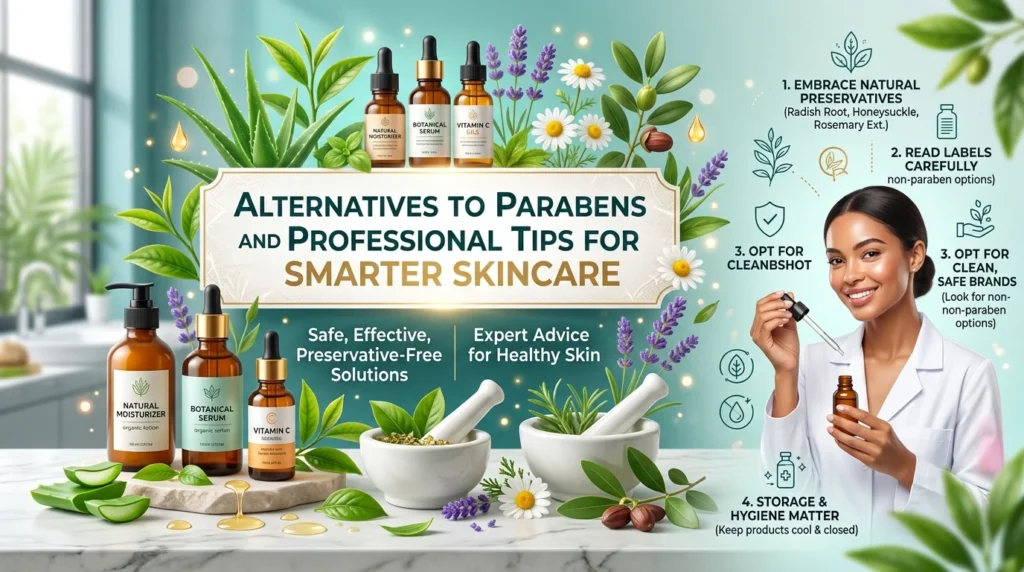
There are several approaches formulators can use instead of parabens. The correct choice depends on the product’s chemistry, packaging, water content, pH, and intended shelf life.
Alternative preservation systems may include phenoxyethanol, sodium benzoate, potassium sorbate, benzyl alcohol, and other ingredients or preservation technologies.
Some formulas also use packaging designed to reduce repeated exposure to air and contaminants.
What professionals consider
Formulators and skincare professionals may consider:
- Product pH.
- Water activity.
- Microbial contamination risk.
- Packaging.
- Ingredient compatibility.
- Stability.
- Intended usage.
- Consumer handling.
This is why a cosmetic product should not be evaluated based on a single ingredient.
Advanced skincare tip
If you are managing persistent acne, eczema-like symptoms, rosacea, severe dryness, or repeated reactions, avoid building a complicated routine based solely on online trends.
A dermatologist can help identify whether the problem is related to your skincare products or an underlying skin condition.
Final best practice
Choose products based on formulation quality, skin compatibility, evidence-informed ingredients, and consistent use.
Conclusion
Paraben free beauty products can be a useful choice for people who prefer to avoid parabens or need to follow specific ingredient restrictions. But the most important lesson is that paraben-free does not automatically mean better, safer, natural, or suitable for every person.
Healthy skincare begins with understanding your skin and keeping your routine practical. Choose gentle products when appropriate, introduce new formulas gradually, protect your skin from the sun, and avoid unnecessary product overload.
Most importantly, do not let complicated beauty marketing make skincare feel stressful. Confidence grows when you understand what you are using and why you are using it.
A simple, consistent routine that your skin tolerates well can support both healthy-looking skin and a more enjoyable approach to self-care. If you experience persistent irritation or have a serious skin concern, consult a qualified dermatologist for personalized guidance.
FAQs
Are paraben free beauty products better for your skin?
Not necessarily. Paraben-free products may suit people who prefer to avoid parabens, but overall skin compatibility depends on the complete formula and your individual needs.
What does paraben free mean on skincare products?
It generally means the product is formulated without parabens such as methylparaben, propylparaben, ethylparaben, or butylparaben.
Are paraben free products safer?
Paraben-free does not automatically mean safer. Cosmetic safety depends on the complete formulation, preservation system, manufacturing, packaging, intended use, and individual sensitivity.
Do paraben free products still contain preservatives?
Yes. Many paraben-free products require alternative preservation systems to help protect water-containing formulas from microbial contamination.
Are paraben free products good for sensitive skin?
They can be, but the label alone does not determine whether a product is suitable for sensitive skin. Fragrance, essential oils, acids, preservatives, and other ingredients may also affect tolerance.
Can I use paraben free skincare every day?
Yes, if the product is designed for regular use and your skin tolerates it. Follow the manufacturer’s directions and avoid overusing active ingredients.
Are natural beauty products always paraben free?
No. Natural and paraben-free are separate concepts. Always check the ingredient list if avoiding parabens is important to you.
Can paraben free makeup cause irritation?
Yes. Makeup can contain many ingredients that may irritate or sensitize certain people. Paraben-free does not mean allergy-proof.
Should I stop using parabens completely?
That is a personal decision unless a healthcare professional has advised you to avoid them. If you have experienced a specific reaction, discuss ingredient avoidance with a dermatologist.
What is the biggest mistake when buying paraben free beauty products?
The biggest mistake is focusing only on the paraben-free label. Always consider the entire ingredient list, your skin type, the product’s purpose, and how your skin responds.