Introduction
Starting a beauty brand can feel exciting, personal, and slightly overwhelming. A founder may have dozens of ideas for cleansers, serums, masks, moisturizers, oils, treatments, makeup, and body-care products. Yet launching everything at once can make a new brand harder to understand and much more expensive to operate.
A focused initial collection with three product types can offer a smarter starting point. Three well-planned products can tell a complete beauty story while keeping the customer journey simple. The goal is not to make the smallest collection possible. The goal is to make the first collection meaningful.
For skincare founders, the first products should support a clear routine and a recognizable brand identity. They should also reflect the founder’s reason for entering the beauty industry. Whether the mission centers on sensitive skin, hydration, barrier care, glow, mature skin, body care, or minimalist beauty, the first three products should work together.
A thoughtful launch can build confidence for both the founder and customer. It can make product education easier, simplify inventory, and give shoppers a reason to try the entire routine.
Featured Snippet
A beauty brand founder can create a strong initial collection with three complementary product types by choosing products that solve a clear customer problem, work together in a simple routine, and express the brand’s identity. A common skincare structure is cleanser, treatment serum, and moisturizer, although other categories may suit different beauty niches.
Why Three Products Can Make a Powerful First Beauty Collection
Three products can give a new beauty brand enough depth to feel intentional without overwhelming customers.
A single product can sometimes make a brand look like it was built around one idea. Five, ten, or twenty products can create the opposite problem. Customers may struggle to understand where to begin.
A three-product collection sits between those extremes.
For example, a skincare founder might launch:
Product typeMain roleCustomer purposeGentle cleanserCleanseRemoves daily buildupTreatment serumTargetAddresses a specific cosmetic concernMoisturizerSupportHydrates and supports the skin barrier
This creates a straightforward journey.
Cleanse → Treat → Moisturize.
That simplicity can help beginners understand the brand quickly.
A focused collection can also make photography, packaging, website design, educational content, sampling, influencer campaigns, and inventory management easier.
Why customers may appreciate a smaller collection
- Easier product selection.
- Less decision fatigue.
- Clearer routine instructions.
- Stronger brand identity.
- More cohesive packaging.
- Easier product education.
- Simple starter bundles.
Founder tip: Do not choose three products simply because three sounds attractive. Choose three products because they have three different jobs.
Real-life example
Imagine a founder wants to build a sensitive-skin brand.
Instead of launching a cleanser, toner, mist, two serums, exfoliant, moisturizer, and mask, the founder could start with a gentle cleanser, barrier-supporting serum, and moisturizer.
The collection immediately communicates its purpose.
Common mistake
One common mistake is launching three versions of essentially the same product.
For example, three different facial oils may create variety, but they do not necessarily create a complete routine.
Best practice: Give each product a distinct role.
Safety consideration
A small collection should not encourage customers to treat cosmetic products as medical treatments. Serious acne, eczema, unexplained rashes, infections, or persistent irritation should be evaluated by a dermatologist.
How a Beauty Brand Founder Should Define the Brand Concept
Before selecting formulas, a founder should answer one basic question:
Who is this brand for, and what problem does it help solve?
This question is more useful than starting with packaging colors or trendy ingredients.
A clear beauty concept can focus on:
- Barrier care.
- Hydration.
- Sensitive skin.
- Mature-looking skin.
- Body care.
- Minimalist skincare.
- Plant-focused beauty.
- Professional haircare.
- Makeup for specific skin tones.
- Wellness-inspired beauty.
The brand concept should influence every part of the collection.
If the brand focuses on sensitive skin, a heavily fragranced collection may send a confusing message.
The brand focuses on active lifestyles, lightweight textures and travel-friendly packaging may make more sense.
If the brand focuses on luxury self-care, texture, sensory experience, packaging, and ritual may become important.
Beginner tip
Write a one-sentence brand statement before developing the products.
For example:
We create simple, effective skincare for people who want comfortable, hydrated skin without a complicated routine.
That sentence can guide product development.
Advanced founder strategy
Create a customer profile.
Think about:
- Age range.
- Skin concerns.
- Budget.
- Lifestyle.
- Beauty habits.
- Existing skincare routine.
- Product preferences.
- Shopping behavior.
- Ingredient preferences.
Frequently overlooked detail
Do not build products only for yourself.
A founder’s personal experience can inspire a brand, but the final collection should solve a broader customer need.
Choosing the Right Three Skincare Product Categories for a New Brand
The most recognizable three-product skincare structure is usually cleanser, treatment, and moisturizer.
However, this is not a universal rule.
The best categories depend on the brand’s positioning.
Option one: Cleanser, serum, moisturizer
This is a classic structure.
It works because each product performs a different routine function.
Option two: Cleanser, moisturizer, sunscreen
This creates a basic daily-care collection.
However, sunscreen has additional regulatory and testing considerations depending on the market.
Option three: Essence, serum, moisturizer
This structure may suit a hydration-focused or K-beauty-inspired concept.
Option four: Body wash, body treatment, body lotion
This can work for a body-care brand.
Option five: Shampoo, conditioner, scalp treatment
This may be better for a haircare founder.
Product selection checklist
- Does each product have a different purpose?
- Can customers understand the routine?
- Does the collection solve a specific problem?
- Can the products work together?
- Is the formulation realistic for the budget?
- Can the founder explain each product easily?
- Are the products appropriate for the intended market?
- Can quality remain consistent at production scale?
Best practice: Build around customer needs rather than forcing every trend into the initial launch.
When to avoid a category
Avoid launching a complicated active treatment simply because it is popular online.
Ingredients such as retinoids, exfoliating acids, or high-strength vitamin C formulas require thoughtful formulation, usage guidance, stability considerations, and appropriate claims.
Building a Cleanser, Treatment, and Moisturizer Skincare Routine
The cleanser-treatment-moisturizer structure works because it follows a logical skincare sequence.
Cleanser
The cleanser prepares the skin by removing sweat, sunscreen, makeup, excess oil, and surface debris.
A gentle cleanser can be especially useful for customers who dislike a tight or stripped feeling after washing.
Treatment
The treatment product becomes the collection’s targeted step.
Depending on the concept, it could focus on hydration, brightening, antioxidant support, texture, or barrier care.
Ingredients might include:
- Niacinamide.
- Hyaluronic acid.
- Vitamin C derivatives.
- Peptides.
- Azelaic acid, where appropriate and legally permitted for the intended cosmetic positioning.
- Panthenol.
- Ceramides.
Moisturizer
The moisturizer helps reduce water loss and supports comfortable, hydrated skin.
Ingredients such as glycerin, ceramides, squalane, shea butter, and fatty alcohols can have useful roles depending on the formulation.
Example routine
Morning: Cleanser → Treatment → Moisturizer → Sunscreen.
Night: Cleanser → Treatment → Moisturizer.
Beginner advice
Customers do not need to apply every product multiple times a day.
The instructions should be simple.
Common mistake
Do not assume that adding more active ingredients makes a formula more effective.
Important tip: Formulation quality, ingredient compatibility, concentration, stability, delivery system, and consistent use all matter.
Selecting Ingredients and Creating a Strong Product Story
Ingredients are important, but a successful beauty brand needs more than a fashionable ingredient list.
The founder should understand why each ingredient appears in the formula.
For example, glycerin is a humectant that helps attract water. Ceramides help support the skin barrier. Squalane can provide an emollient feel. Niacinamide is commonly used in skincare formulations for several cosmetic benefits.
However, ingredient selection should reflect the product’s purpose.
A hydration serum does not need every popular ingredient on social media.
A moisturizer designed for dry skin may benefit more from a well-balanced blend of humectants, emollients, and occlusive ingredients than from a long list of trendy extracts.
Product story example
Instead of saying:
This serum contains 25 amazing ingredients.
A stronger message might be:
A lightweight daily serum designed to provide comfortable hydration and support a healthy-looking skin barrier.
The second message is easier for customers to understand.
Advanced formulation tip
Founders should work with qualified cosmetic formulators and appropriate testing laboratories rather than attempting complex formulation development without professional support.
Safety warning
Avoid unsupported claims such as cures acne, removes eczema, reverses aging, or heals damaged skin unless the product and claims meet the relevant legal and regulatory requirements.
Cosmetic products should be marketed responsibly.
Matching the First Three Products to Different Skin Types
A beauty brand should know whether its products are intended for dry, oily, combination, sensitive, normal, or multiple skin types.
Dry skin
A collection for dry skin may emphasize:
Glycerin, hyaluronic acid, ceramides, squalane, and nourishing emollients.
Creamier textures may feel more comfortable.
Oily skin
Lightweight gels and lotions may be preferred.
However, oily skin still needs hydration.
Combination skin
Balanced formulas can work across different facial areas.
Sensitive skin
A founder may consider simple formulas and avoid unnecessary fragrance.
However, vegan, natural, or botanical does not automatically mean gentle.
Mature skin
A mature-skin collection may focus on hydration, antioxidants, peptides, and daily sun protection.
Real-life example
A founder targeting young adults with oily and combination skin might choose a low-foaming cleanser, lightweight niacinamide serum, and gel moisturizer.
A founder targeting dry, mature skin may choose a creamy cleanser, peptide-focused treatment, and richer moisturizer.
Product selection advice
Do not promise that one collection will solve every skin concern.
A narrower promise can create stronger credibility.
Best practice: Choose one primary customer group and design the collection around that person’s routine.
Creating Morning, Night, Weekly, and Seasonal Beauty Routines
The initial collection should come with clear usage instructions.
Customers should know not only what each product does, but also when to use it.
Morning routine
A simple morning routine could be:
- Cleanse.
- Apply the treatment.
- Moisturize.
- Apply broad-spectrum sunscreen.
Sunscreen should be included in the routine even if it is not part of the brand’s initial product collection.
Night routine
At night:
- Remove makeup and sunscreen.
- Cleanse.
- Apply treatment.
- Moisturize.
Weekly routine
A three-product collection does not necessarily require an exfoliating mask or scrub.
If exfoliation is necessary, customers can add a separate product that suits their skin.
Do not encourage unnecessary exfoliation simply to make the routine appear more advanced.
Seasonal adjustments
Dry winter weather may call for richer moisturizing textures.
Hot weather may make lightweight formulas more comfortable.
Travel can increase the value of simple, portable packaging.
Frequently overlooked tip
The routine should work in real life.
A five-minute routine that a customer uses consistently may be more useful than a twelve-step routine that they abandon after one week.
Product Development, Formulation Testing, and Beauty Safety
Behind every successful beauty launch is a significant amount of product development.
A founder should plan for:
- Concept development.
- Ingredient research.
- Formula development.
- Prototype testing.
- Stability testing.
- Packaging compatibility.
- Microbiological testing where appropriate.
- Preservative effectiveness testing where appropriate.
- Safety evaluation.
- Label review.
- Regulatory review.
- Manufacturing.
- Quality control.
Testing requirements vary by product and market.
Why stability matters
A formula should remain acceptable under appropriate conditions throughout its intended shelf life.
The product should maintain its expected appearance, smell, texture, and performance.
Packaging compatibility
A formula can interact with packaging.
For example, some ingredients may require packaging that limits exposure to air or light.
Beginner founder mistake
Do not select packaging solely because it looks beautiful.
The package needs to protect the formula and support convenient use.
Advanced founder tip
Conduct packaging compatibility testing before committing to a large production order.
Safety rule
Never skip required testing to save money.
A cheaper launch can become extremely expensive if products develop contamination, stability problems, packaging failures, or customer safety issues.
Packaging, Branding, and the Customer Experience
A three-product collection should look like a family.
The products should feel connected through:
- Typography.
- Color.
- Shape.
- Materials.
- Product naming.
- Photography.
- Tone of voice.
- Instructions.
The goal is not necessarily identical packaging.
Instead, create visual consistency.
Example
A minimalist skincare brand might use neutral packaging, simple labels, and clean typography.
A playful beauty brand might use brighter colors and expressive names.
Both approaches can work if they match the target customer.
Packaging information
Customers should be able to find important details easily.
Depending on the market and product, packaging may need information such as:
- Product identity.
- Net quantity.
- Ingredient information.
- Directions.
- Warnings.
- Responsible company information.
- Required regulatory statements.
Common mistake
Do not make the front of the package so decorative that customers cannot quickly identify what the product does.
Best practice: Beautiful packaging should still communicate clearly.
Pricing, Profit Margins, Inventory, and Launch Planning

A founder needs to understand the economics before finalizing the collection.
Costs can include:
- Formula development.
- Testing.
- Ingredients.
- Manufacturing.
- Packaging.
- Labels.
- Freight.
- Warehousing.
- Photography.
- Website development.
- Marketing.
- Samples.
- Returns.
- Retail margins.
A three-product collection may appear small, but each SKU creates its own expenses.
Simple pricing example
Suppose a product costs $8 to manufacture and package before other business expenses.
Selling it for $10 may not create a sustainable business.
The founder needs to account for fulfillment, payment processing, marketing, overhead, returns, taxes, wholesale discounts, and other expenses.
Inventory planning
Do not automatically order equal quantities of all three products.
Demand may differ.
A cleanser could be used more frequently than a treatment.
Launch strategy
A founder can consider:
- Starter bundles.
- Individual products.
- Discovery sets.
- Limited launch offers.
- Sampling.
- Email campaigns.
- Educational content.
- Creator partnerships.
Important tip: Do not discount heavily before understanding the product’s economics.
Common mistake
Launching with too much inventory can tie up cash.
Launching with too little can create stockouts.
The right quantity depends on production minimums, expected demand, lead times, and available capital.
Vegan, Clean, Cruelty-Free, Sustainable, and Other Beauty Claims
Today’s beauty customers often look for specific product attributes.
A founder may want the collection to be:
- Vegan.
- Cruelty-free.
- Fragrance-free.
- Plant-based.
- Organic.
- Sustainable.
- Refillable.
- Dermatologist tested.
- Clean beauty.
These terms should not be treated as interchangeable.
Vegan generally refers to avoiding animal-derived ingredients.
Cruelty-free generally relates to animal testing policies.
Organic involves specific agricultural standards where applicable.
Natural can have different meanings depending on the market and standard.
Why claims matter
A founder needs evidence to support product claims.
Do not put a trendy badge on packaging simply because competitors use one.
Best practice
Maintain documentation for:
- Ingredient sourcing.
- Supplier information.
- Testing.
- Certifications.
- Manufacturing.
- Claims substantiation.
Safety and trust
Transparent claims can strengthen customer confidence.
Unsupported claims can do the opposite.
Frequently overlooked tip: If a brand says a product is vegan, confirm the sourcing of ingredients that can have different origins, such as glycerin or squalane.
Common Mistakes New Beauty Brand Founders Should Avoid
The excitement of launching can cause founders to move too quickly.
Here are some of the biggest mistakes.
Launching too many products
More products mean more formulas, inventory, packaging, testing, and customer education.
Copying competitors
A successful competitor’s formula or aesthetic does not automatically fit your brand.
Chasing every trend
An ingredient can become popular online and disappear months later.
Ignoring the customer
A founder may love a product that the target audience does not understand.
Making excessive claims
Claims must be accurate and appropriate for the product and market.
Underestimating testing
Testing is part of responsible product development.
Choosing packaging before formula development
The formula and packaging need to work together.
Making the routine complicated
Customers often appreciate clear instructions.
Forgetting customer feedback
Reviews and customer questions can reveal problems the founder did not anticipate.
Warning box
Never use customer testimonials as a substitute for proper product safety evidence.
Beginner rule
Before adding a fourth product, ask whether the first three are:
Profitable, useful, loved, understood, and operationally stable.
If not, improve the existing collection first.
Marketing, Content, Social Media, and Product Education for a Three-Product Launch
A small collection can actually make content marketing easier.
Each product can have multiple educational angles.
A cleanser can inspire content about cleansing mistakes.
A serum can support ingredient education.
A moisturizer can inspire barrier-care content.
The entire collection can become a routine tutorial.
Content ideas
- Morning routine videos.
- Night routine demonstrations.
- Ingredient explainers.
- Founder story.
- Product development behind the scenes.
- Packaging reveals.
- Texture demonstrations.
- Frequently asked questions.
- Customer reviews.
- Routine guides.
- Skin-type education.
Social media strategy
Avoid making every post a sales pitch.
Teach customers something useful.
For example:
Three signs your cleanser may be too harsh.
Then explain what customers should look for.
This builds authority while naturally connecting the content to the cleanser.
Voice-search optimization
Answer questions customers might ask aloud:
- What three skincare products do I need?
- What order should I apply skincare?
- Should I use serum before moisturizer?
- What is a simple skincare routine?
- How do I choose products for dry skin?
Google Discover strategy
Strong visual storytelling can make beauty content more engaging.
Use original photography, useful explanations, authentic founder stories, and genuinely helpful product education.
Best practice: Make the content useful even when the reader is not ready to buy.
Expanding the Beauty Collection After the First Launch
Three products should not necessarily remain three products forever.
Expansion should follow customer demand.
After launch, study:
- Best-selling SKU.
- Repeat purchase rate.
- Customer reviews.
- Return reasons.
- Frequently requested products.
- Website searches.
- Customer questions.
- Product combinations.
- Inventory speed.
Suppose customers repeatedly request sunscreen.
That could become a logical fourth product.
If customers ask for a richer moisturizer during winter, a seasonal variation might make sense.
If the hero serum sells extremely well, a complementary treatment may be appropriate.
Smart expansion order
A founder might consider:
Initial three → solve obvious customer request → improve existing formulas → expand into adjacent category.
Avoid unnecessary expansion
A product should earn its place.
Ask:
Does this product solve a real problem for existing customers?
If the answer is unclear, wait.
Advanced strategy
Use customer data to identify gaps.
If customers frequently purchase the serum but buy their moisturizer elsewhere, the moisturizer may need improvement.
That is more valuable information than simply launching another serum.
Alternative approach
Instead of creating a new SKU, improve the existing collection through:
- New sizes.
- Travel formats.
- Bundles.
- Refills.
- Limited editions.
- Seasonal packaging.
This can increase variety without immediately multiplying formulation complexity.
Expert Strategy for Creating a Memorable Three-Product Beauty Brand
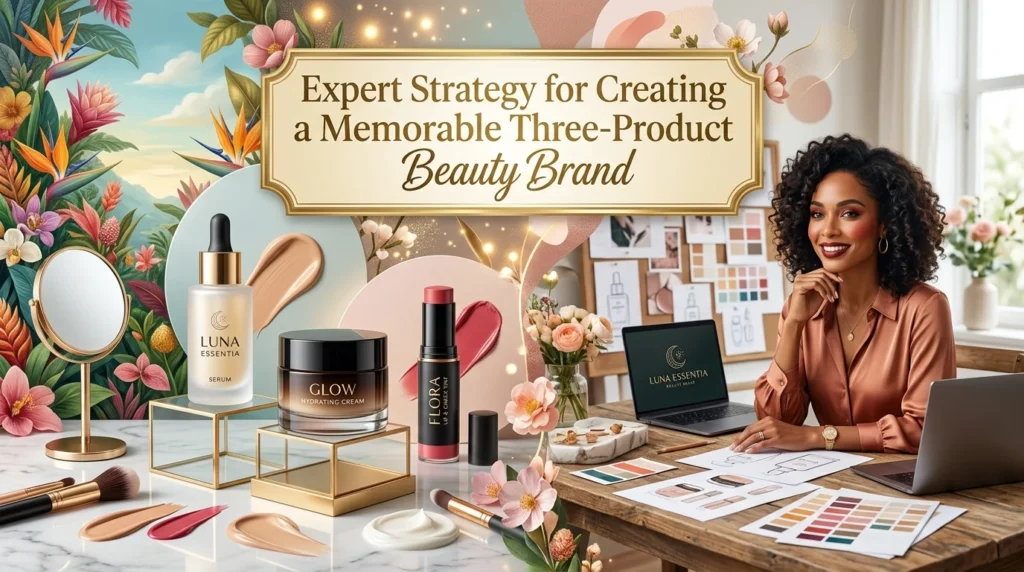
The strongest three-product collections usually have one thing in common: they make sense together.
The founder should be able to explain the collection in one sentence.
For example:
Three simple products designed to cleanse, hydrate, and support comfortable-looking skin.
That is easy to understand.
A more targeted brand might say:
A three-step barrier-care routine for dry and sensitive-feeling skin.
Again, the customer immediately understands the concept.
The three-product founder framework
Think about the collection through five questions.
Who? Who is the customer?
Problem? What beauty problem or routine challenge are you addressing?
Product? Which three products solve it?
Proof? What evidence supports the product’s claims?
Promise? What can customers realistically expect?
Product hierarchy
Every collection should have a role for each product.
RoleProductPurposeEntry productCleanserEasy introductionHero productTreatmentMain differentiationLoyalty productMoisturizerDaily routine and repurchase
This is only a strategic framework, not a rule.
Founder story
A founder’s story can make a collection emotionally memorable.
But the story should support the products rather than replace product quality.
Customers may love the founder’s journey, but they return because the product performs well for them.
Professional recommendation
Work with experienced professionals for formulation, regulatory review, testing, manufacturing, packaging, and claims.
A founder can lead the vision without personally doing every technical task.
Final checklist for founders
- Define the target customer.
- Choose one clear beauty problem.
- Select three complementary products.
- Assign a specific role to each SKU.
- Research ingredients carefully.
- Work with qualified formulators.
- Test formulas and packaging.
- Verify claims.
- Build consistent packaging.
- Calculate full product economics.
- Plan inventory carefully.
- Create educational content.
- Collect customer feedback.
- Improve before expanding.
Frequently overlooked lesson: A memorable beauty brand is not created by having the longest product list. It is created by having a clear reason for every product that customers can understand and trust.
Conclusion
Creating an initial collection with three product types as a beauty brand founder can be an excellent way to begin with focus and purpose. Three products can create a complete routine, communicate a clear brand message, simplify customer education, and make early operations more manageable.
The classic cleanser, treatment, and moisturizer structure works for many skincare concepts, but it is not the only option. Haircare, body care, makeup, sun care, and specialized skincare brands may need different product combinations.
The most important principle is simple: choose products based on customer needs rather than trends alone.
Develop strong formulas. Use responsible claims. Test products properly. Design packaging that protects the formula. Keep instructions clear. Listen carefully to customer feedback.
Most importantly, remember that beauty is connected to confidence and self-care, but a brand should never promise unrealistic perfection. Healthy-looking skin comes from consistent care, appropriate products, sun protection, and realistic expectations.
A three-product launch is only the beginning. If those first products genuinely help customers and create trust, the founder has a strong foundation for building a much larger beauty brand.
FAQs
What are the best three skincare products for a new brand?
A common starting structure is cleanser, serum or treatment, and moisturizer. A different combination may be more appropriate for a body-care, haircare, makeup, or sun-care brand.
Why do beauty founders start with a small collection?
A smaller collection can simplify product development, inventory, packaging, marketing, education, and customer choice. It also allows founders to learn from customers before investing in a much larger range.
Should a new beauty brand launch with many products?
Usually, a founder should avoid adding products without a clear customer reason. Every new SKU adds formulation, testing, inventory, packaging, marketing, and operational complexity.
How do I choose the right product types for my beauty brand?
Start with the target customer and their main routine problem. Then select three products that solve different parts of that problem. Make sure the formulas, price points, packaging, and brand story support the same positioning.
Can a beauty brand start with only one product?
Yes. A single-product brand can work when the product has strong differentiation, a clear audience, and a compelling reason to exist. However, three complementary products can make the brand’s routine and positioning easier to communicate.
What is the most important product in a three-product skincare collection?
There is no universal answer. Many brands make the treatment or serum their hero product because it can provide differentiation, while the cleanser and moisturizer support the overall routine.
Should a skincare founder create products for every skin type?
Not necessarily. A focused target audience can make product development and marketing clearer. A founder can expand later after understanding customer demand.
What testing does a beauty product need?
Testing varies by formula and market. Depending on the product, founders may need stability, microbiological, preservative-effectiveness, packaging compatibility, safety, and other appropriate evaluations. Regulatory professionals and qualified laboratories can help determine requirements.
Are vegan beauty products automatically better?
No. Vegan refers primarily to the absence of animal-derived ingredients. A vegan formula can still contain ingredients that do not suit a particular skin type. Customers should evaluate the complete formulation.
Is cruelty-free the same as vegan?
No. Vegan generally concerns animal-derived ingredients, while cruelty-free generally concerns animal testing policies. A product can meet one claim without automatically meeting the other.