Introduction
Beauty does not always have to come from a crowded bathroom shelf. Sometimes, the most enjoyable part of self-care is creating something simple with ingredients you already understand. DIY beauty products can make skincare feel more personal, affordable, and mindful while encouraging you to pay closer attention to what you put on your skin.
From gentle face masks and body scrubs to simple hair treatments, homemade beauty recipes can fit many routines. However, natural does not automatically mean safe. Lemon juice, undiluted essential oils, abrasive scrubs, contaminated water-based mixtures, and other popular DIY ingredients can irritate the skin or cause unwanted reactions.
The goal is not to make everything yourself. Instead, it is to learn which homemade beauty ideas are reasonable, which ingredients deserve caution, and when a professionally formulated product is the better choice. With a little knowledge, DIY beauty can become a thoughtful addition to a healthy skincare and wellness routine.
Featured Snippet
DIY beauty products are homemade skincare, haircare, and body-care preparations made from selected ingredients. Simple options such as fresh oatmeal masks, oil-based body treatments, and sugar scrubs can support self-care, but hygiene, ingredient safety, proper dilution, patch testing, and short storage times are essential.
What DIY Beauty Products Are and How Homemade Skincare Works
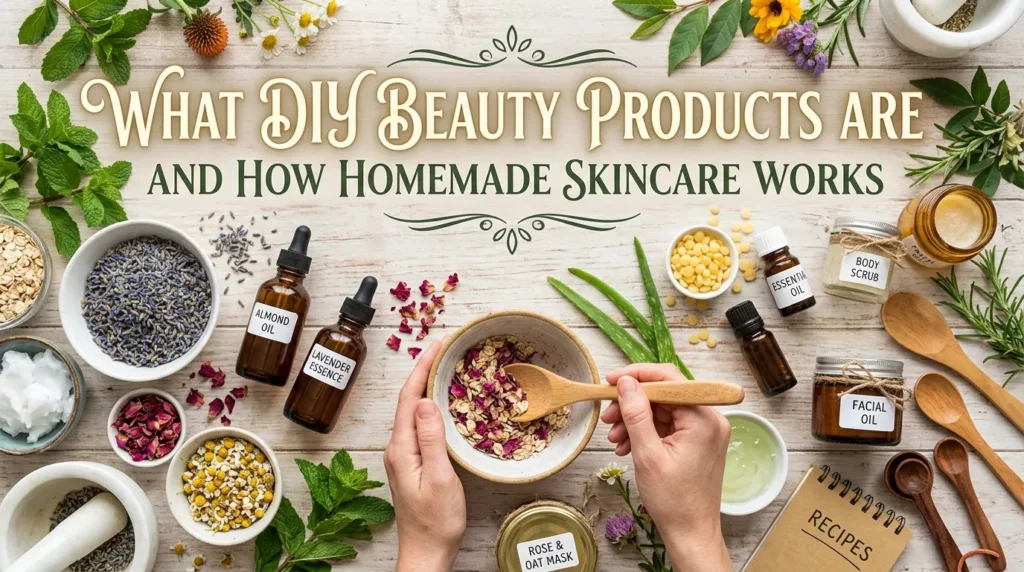
DIY beauty products are personal-care preparations made at home using ingredients selected for a specific purpose. They may include face masks, body scrubs, hair treatments, bath preparations, lip treatments, or simple oil-based products.
The attraction is easy to understand. You control the ingredients, avoid unnecessary fragrance if desired, and can create small quantities for occasional use. DIY beauty can also make a routine feel more enjoyable because the process itself becomes part of self-care.
However, homemade skincare does not automatically work better than professionally formulated skincare. Cosmetic formulators carefully consider pH, preservation, stability, concentration, compatibility, texture, and contamination risk.
A beginner should therefore start with simple preparations rather than attempting to duplicate commercial serums or creams.
How DIY skincare can work
Depending on the ingredients, homemade treatments may:
- Add temporary hydration.
- Soften dry-feeling skin.
- Remove surface oils and debris.
- Physically exfoliate dead surface cells.
- Condition dry hair.
- Provide a relaxing self-care experience.
- Reduce the number of unnecessary products in a routine.
For example, finely ground oatmeal mixed with water can create a soothing-feeling paste for many people. A simple sugar-and-oil body scrub can provide physical exfoliation, although it should be used gently.
Beginner best practice
Start with one or two simple ingredients. Avoid complicated recipes containing ten or more ingredients because it becomes difficult to identify the cause of irritation if something goes wrong.
Important: DIY skincare should complement, not replace, proven treatments for acne, eczema, rosacea, infections, severe dryness, or other persistent skin concerns.
Benefits of Homemade Skincare and Natural Beauty Products
One of the biggest benefits of DIY beauty products is control. You can decide what goes into a preparation and leave out ingredients you personally prefer to avoid.
Cost can also be attractive. Basic pantry ingredients may be inexpensive, although buying numerous specialty ingredients can quickly make DIY beauty more expensive than expected.
Potential benefits
Customization is particularly useful. Someone with dry-feeling skin may prefer an oil-based body treatment, while someone who dislikes fragrance can make a fragrance-free preparation.
Other possible advantages include:
- Smaller product quantities.
- Less unnecessary packaging.
- Greater ingredient awareness.
- Convenient occasional treatments.
- Personalized textures.
- A relaxing self-care ritual.
- Potentially lower cost for simple recipes.
Real-life example
Imagine someone who regularly buys expensive body scrubs but only uses them once a week. A small homemade sugar-and-oil scrub may provide a simpler alternative for occasional body exfoliation.
That does not mean the DIY scrub is inherently superior. A store-bought exfoliant may offer better consistency, preservation, and controlled formulation.
Common mistake
Many people assume that natural equals gentle. This is one of the most important DIY beauty myths to avoid.
Natural ingredients can still cause irritation or allergy. Essential oils, botanicals, acids, spices, and fragrances may be particularly problematic for sensitive individuals.
Expert-minded approach
Think of DIY beauty as ingredient education rather than a race to replace every commercial product. Keep recipes simple, use clean equipment, avoid risky ingredients, and stop immediately if burning, swelling, blistering, or significant irritation occurs.
Best Ingredients for DIY Face and Body Care
Ingredient selection determines whether a homemade beauty treatment is sensible or unnecessarily risky. The safest starting point is usually a short list of familiar, minimally processed ingredients.
Beginner-friendly options
Colloidal oatmeal or finely ground plain oats can be useful in simple soothing-style preparations.
Plain yogurt contains lactic acid, but homemade yogurt masks have uncontrolled concentration and may irritate some skin types. Avoid treating them like professional chemical peels.
Honey is often used in traditional beauty routines because it has humectant properties, meaning it can help attract and retain water. It can still cause irritation or allergy in some people.
Plant oils such as jojoba, sunflower, or mineral oil can be useful for reducing the feeling of dryness by helping limit water loss from the skin.
Aloe vera gel can feel cooling and soothing, but fresh plant preparations can vary considerably and may not be appropriate for everyone.
Ingredients requiring extra caution
- Lemon or lime juice.
- Undiluted essential oils.
- Baking soda.
- Toothpaste.
- Undiluted apple cider vinegar.
- Strong spices.
- Rough salt crystals.
- Coarse coffee grounds for facial exfoliation.
- Hydrogen peroxide.
- Undiluted acids.
Do not use kitchen ingredients simply because a social-media recipe recommends them.
Product selection advice
For a DIY preparation, choose ingredients that are:
- Fresh and clean.
- Clearly identifiable.
- Appropriate for cosmetic use.
- Free from unnecessary additives.
- Stored according to their instructions.
For sensitive skin, fragrance-free options are usually a more cautious starting point.
DIY Facial Masks for Different Skin Types
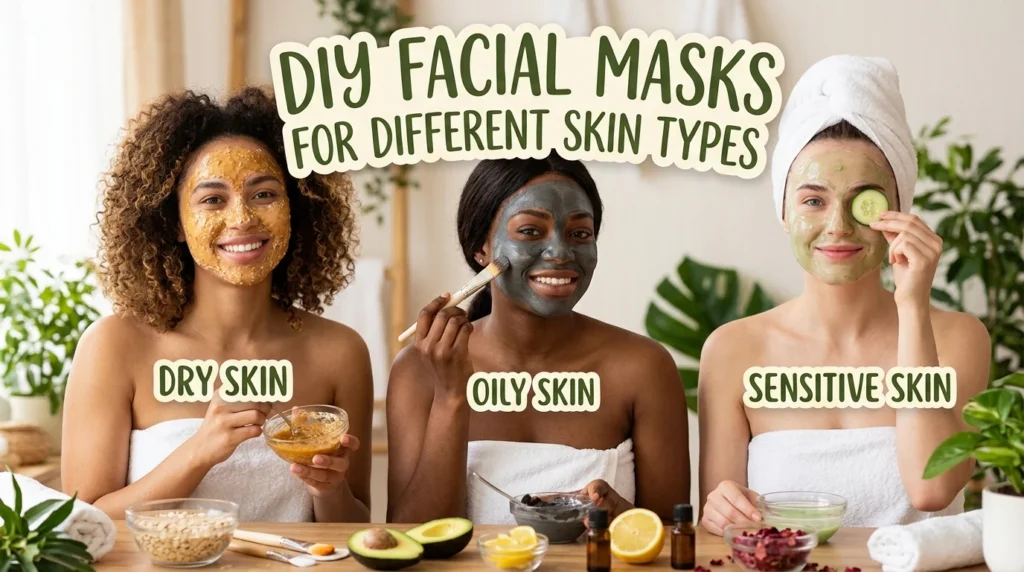
Face masks are among the most popular DIY beauty products because they are simple and usually intended for occasional use.
The important point is to match the mask to your skin’s needs rather than copying every trending recipe.
For dry-feeling skin
A simple oatmeal-and-water mask may provide a comfortable, softening experience.
You can also use a small amount of a suitable facial oil after cleansing if your skin tolerates oils well.
For oily skin
Avoid trying to strip every trace of oil from your face. Overly aggressive cleansing can leave skin feeling tight and uncomfortable.
A simple clay mask may be an option, but it should not be allowed to become painfully dry or cracked. Follow with a lightweight moisturizer.
For combination skin
Consider applying different products to different areas. A gentle clay treatment may suit the oilier T-zone, while the cheeks may benefit from a more moisturizing approach.
For sensitive skin
Keep things extremely simple.
Plain finely ground oatmeal mixed with water is generally a more cautious DIY option than recipes containing essential oils, acids, fragrance, or spices.
Mask safety checklist
- Patch test first.
- Keep contact time short.
- Never use a mask on broken skin.
- Avoid the eye area.
- Do not scrub aggressively afterward.
- Rinse thoroughly.
- Moisturize if needed.
- Stop if you experience burning or significant redness.
When to avoid DIY face masks
Skip homemade treatments when your skin is actively irritated, sunburned, peeling, or experiencing an unexplained rash.
If persistent redness, itching, swelling, painful acne, or scaling continues, a dermatologist can help identify the underlying problem.
Homemade Exfoliators and Body Scrubs
Exfoliation removes surface cells through either physical or chemical methods. DIY body scrubs generally rely on physical exfoliation.
Sugar, finely ground oats, and some oils are commonly used in homemade body scrubs.
A simple body scrub concept
A basic body scrub can combine a small amount of fine sugar with a suitable oil. Use gentle circular movements and rinse thoroughly.
The objective is gentle exfoliation, not aggressive friction.
Benefits
A body scrub may:
- Smooth rough-feeling skin.
- Temporarily improve softness.
- Help remove surface buildup.
- Make moisturizer feel easier to apply afterward.
Areas requiring caution
Do not use rough scrubs on:
- The face.
- Broken skin.
- Freshly shaved or waxed areas.
- Sunburn.
- Active rashes.
- Inflamed acne.
- Areas with significant irritation.
Coffee grounds and large salt crystals may feel satisfying but can be too abrasive for delicate facial skin.
Over-exfoliation warning
More exfoliation does not mean better skin.
If your skin becomes tight, shiny, red, sore, or unusually sensitive, reduce exfoliation and focus on barrier-friendly care.
Beginner tip: Start with once weekly body exfoliation rather than making it a daily habit.
DIY Moisturizers, Oils, and Nourishing Beauty Treatments
Moisturization is about maintaining comfortable skin and supporting the skin barrier. DIY moisturization can be simple, but homemade creams are much more complicated than they appear.
A true cream usually requires water, oils, emulsifiers, preservatives, and careful formulation. Without proper preservation, water-based homemade creams can develop microbial contamination even when they look and smell normal.
For this reason, beginners should generally avoid storing homemade water-based lotions.
Safer simple approach
Oil-based treatments are easier to manage than water-containing creams.
A few drops of a suitable oil can be applied to slightly damp body skin. This may help reduce the feeling of dryness by slowing water loss.
Oils to consider
- Jojoba oil.
- Sunflower oil.
- Mineral oil.
- Squalane, when using a commercially formulated version.
- Coconut oil for areas where it is tolerated.
Not every oil works for every face. Coconut oil, for example, may feel too heavy or clog-prone for some acne-prone individuals.
Frequently overlooked tip
Moisturizer does not need to feel greasy to work.
If DIY oils make your skin uncomfortable, a professionally formulated moisturizer may be a better choice.
When to avoid oils
Avoid applying an unfamiliar oil to inflamed or damaged skin without testing it first. Stop if itching, redness, bumps, or burning develops.
Homemade Haircare and Scalp Treatments
DIY beauty products are not limited to skincare. Homemade haircare treatments are also popular.
Hair strands are different from living skin tissue, so a treatment that makes hair feel conditioned does not necessarily improve the health of the scalp.
Simple hair treatments
A small amount of coconut oil or another compatible oil may be used as a pre-shampoo treatment on dry hair.
This can be particularly useful for hair that feels rough or dry.
However, oily scalp conditions may become uncomfortable when heavy oils are applied directly to the scalp.
For dry hair
Consider applying a small amount of oil to the mid-lengths and ends before washing.
For oily scalp
Focus on gentle cleansing rather than adding more oil. Heavy DIY oil treatments may worsen the greasy feeling.
Avoid risky hair recipes
Do not use household bleach, strong acids, concentrated essential oils, or harsh cleaning substances on your scalp.
Also avoid believing that DIY recipes can permanently change hair growth patterns or cure scalp disorders.
Professional tip
Persistent dandruff, scaling, sores, sudden hair loss, or scalp inflammation deserves professional evaluation rather than repeated DIY experiments.
Simple DIY Beauty Products for Beginners
If you are completely new to homemade beauty, simplicity should be your biggest rule.
You do not need a kitchen full of powders, oils, botanical extracts, and essential oils.
DIY ideas
- Oatmeal and water soothing-style face mask.
- Fine sugar and oil body scrub.
- Simple oil treatment for dry body areas.
- Oat-based bath soak.
- Pre-shampoo hair oil treatment.
- Honey-based occasional treatment if tolerated.
checklist
- Use clean utensils.
- Make small batches.
- Avoid water-based products for long-term storage.
- Patch test unfamiliar ingredients.
- Label homemade preparations.
- Do not share homemade skincare.
- Discard anything that changes unexpectedly.
mistake
A common mistake is making a large jar because the recipe looks inexpensive.
This creates unnecessary contamination risk. Homemade beauty products are generally best prepared in quantities designed for immediate or very short-term use.
Morning, Evening, Weekly, and Seasonal DIY Beauty Routines
DIY treatments should fit around a basic skincare routine rather than becoming the entire routine.
Morning routine
A simple morning routine can include:
- Gentle cleansing if needed.
- Moisturizer.
- Broad-spectrum sunscreen SPF 30 or higher.
Sunscreen is one area where a professionally tested commercial product is strongly preferable to DIY formulations.
Evening routine
At night:
- Remove makeup and sunscreen.
- Cleanse gently.
- Apply a suitable moisturizer.
- Use an occasional DIY treatment only when your skin is comfortable.
Weekly routine
Once a week, you might use:
- A gentle body scrub.
- An oatmeal mask.
- A hair oil treatment.
- A relaxing bath soak.
You do not need to perform every treatment every week.
Seasonal adjustments
Winter may call for more moisturizing care, while hot and humid weather may make heavy oils feel uncomfortable.
During summer, sun protection becomes especially important. DIY products should never replace sunscreen.
Advanced tip
Keep a simple skincare journal. Record new ingredients and note whether your skin feels better, worse, or unchanged.
This can help you identify patterns instead of constantly changing products.
DIY Beauty Products for Sensitive and Problem-Prone Skin
Sensitive skin benefits from restraint.
When the skin barrier is irritated, introducing several homemade ingredients at once can make it difficult to identify what caused the reaction.
A gentle strategy
Choose one simple ingredient at a time.
For example, an oatmeal-based preparation may be easier to evaluate than a recipe containing oatmeal, honey, lemon, essential oils, and multiple botanical extracts.
Sensitive-skin rules
Avoid fragrance when possible.
aggressive exfoliation.
Avoid essential oils on irritated skin.
Never apply DIY acids without understanding their concentration and risks.
Do not experiment on broken skin.
Acne-prone skin
DIY treatments cannot replace evidence-based acne care. Heavy oils may also cause problems for some acne-prone users.
Avoid squeezing pimples after a DIY mask because additional irritation can worsen inflammation.
Eczema, rosacea, and persistent irritation
If you have a diagnosed or suspected skin condition, be particularly cautious with homemade products.
A dermatologist can recommend treatments based on the actual condition rather than relying on general beauty recipes.
Warning signs
Stop using a DIY preparation if you develop:
- Burning.
- Swelling.
- Blistering.
- Severe itching.
- Hives.
- Persistent redness.
- New widespread rash.
Seek medical care for severe or rapidly worsening reactions.
Ingredients and DIY Beauty Recipes to Avoid for Skin Safety
Some DIY beauty recipes remain popular online despite having significant drawbacks.
Lemon and lime juice
Citrus juice can irritate skin and may increase sensitivity to sunlight. Applying citrus juice directly to the face is not a good beginner skincare practice.
Baking soda
Baking soda is alkaline, while healthy skin has a naturally acidic surface environment. Frequent use may disrupt the skin barrier and cause irritation.
Toothpaste
Toothpaste is designed for teeth, not facial skin. It can contain ingredients that irritate the face.
Undiluted essential oils
Essential oils are highly concentrated. They can trigger irritation or allergic reactions when used incorrectly.
Rough physical scrubs
Coarse particles can cause excessive friction, particularly on facial skin.
DIY sunscreen
Do not make sunscreen at home.
Sunscreen requires validated testing to determine its protection level and stability. Homemade oils and mineral mixtures cannot reliably replace a tested sunscreen.
Myth versus fact
MythFactNatural means safeNatural ingredients can still irritate or cause allergies.More exfoliation gives better skinExcessive exfoliation can damage the skin barrier.DIY sunscreen is enoughSun protection should come from a properly tested sunscreen.Essential oils are always gentleConcentrated essential oils can cause irritation.Homemade products last for monthsWater-containing DIY products can spoil without proper preservation.
Hygiene, Preservation, Storage, and Patch Testing
Safety is the part of DIY beauty that deserves the most attention.
A homemade product can become contaminated even when the ingredients originally looked clean.
Basic hygiene
Wash your hands before preparing a treatment. Clean utensils and containers thoroughly and avoid touching the product repeatedly.
Never dip dirty fingers into a homemade preparation.
Storage
Water-based mixtures are especially difficult because bacteria, yeast, and mold can grow without obvious warning.
For beginners, the safest approach is to make fresh, small amounts and avoid storing water-based mixtures.
Keep ingredients in their original containers whenever possible and follow manufacturer storage recommendations.
Patch testing
Apply a small amount of the preparation to a limited area first.
Wait and monitor the skin before using the product more widely.
A patch test cannot guarantee that a reaction will never occur, but it is a useful precaution.
Discard immediately if
- The smell changes.
- The texture changes.
- Mold appears.
- The color changes unexpectedly.
- The container becomes swollen.
- The product has been contaminated.
When in doubt, throw it out.
This is particularly important for homemade beauty products containing water, fresh food, or other perishable ingredients.
DIY Versus Store-Bought Beauty Products
DIY beauty and commercial skincare each have advantages.
The right choice depends on the product, your skin, your goals, and your tolerance for experimentation.
FeatureDIY Beauty ProductsStore-Bought ProductsIngredient controlHighModerate to highPreservationOften limitedProfessionally formulatedConvenienceModerateHighStabilityVariableUsually testedCostCan be lowWide rangeCustomizationHighModerateSafety testingUsually limitedOften more extensiveComplex active ingredientsDifficultEasier to obtainSunscreenNot recommendedStrongly preferred
When DIY makes sense
DIY can be enjoyable for simple, occasional treatments such as body scrubs, oatmeal preparations, or basic hair oil treatments.
When commercial products are better
Choose professionally formulated products when you need:
- Sunscreen.
- A stable moisturizer.
- A treatment containing carefully controlled active ingredients.
- Preserved water-based products.
- Products for a diagnosed skin condition.
- Consistent concentrations.
Buying guide
If you purchase a commercial product, look for:
Clear ingredient labeling, appropriate packaging, reputable manufacturing, and claims that do not sound too good to be true.
A higher price does not automatically mean higher quality.
Advanced Homemade Beauty Ideas and Personalization Tips
Once you understand basic ingredient safety, you may want to customize your routine.
However, advanced DIY should mean better decision-making, not more complicated recipes.
Create a simple ingredient strategy
Instead of combining multiple actives, decide what your primary goal is.
For example:
- Dryness → focus on moisturizing and barrier support.
- Rough body skin → gentle exfoliation plus moisturization.
- Dry hair → conditioning and careful oil use.
- Relaxation → simple bath or body rituals.
Avoid DIY formulation of complex products
Professional formulation becomes particularly important when a product contains:
- Multiple active ingredients.
- Water and oils.
- Preservatives.
- Emulsifiers.
- pH-dependent ingredients.
- Strong exfoliating acids.
- Retinoid-like ingredients.
- High concentrations of botanical extracts.
Advanced best practice
Learn basic cosmetic science before attempting complex formulations.
Understand:
- pH
- Preservation
- Emulsification
- Oxidation
- Ingredient concentration
- Packaging
- Microbial contamination
This knowledge helps separate responsible DIY beauty from viral beauty hacks.
Personalization example
If you enjoy making body products but have sensitive facial skin, keep DIY experimentation limited to the body.
There is no rule saying every part of your beauty routine needs to be homemade.
Latest DIY Beauty Trends and Sustainable Self-Care
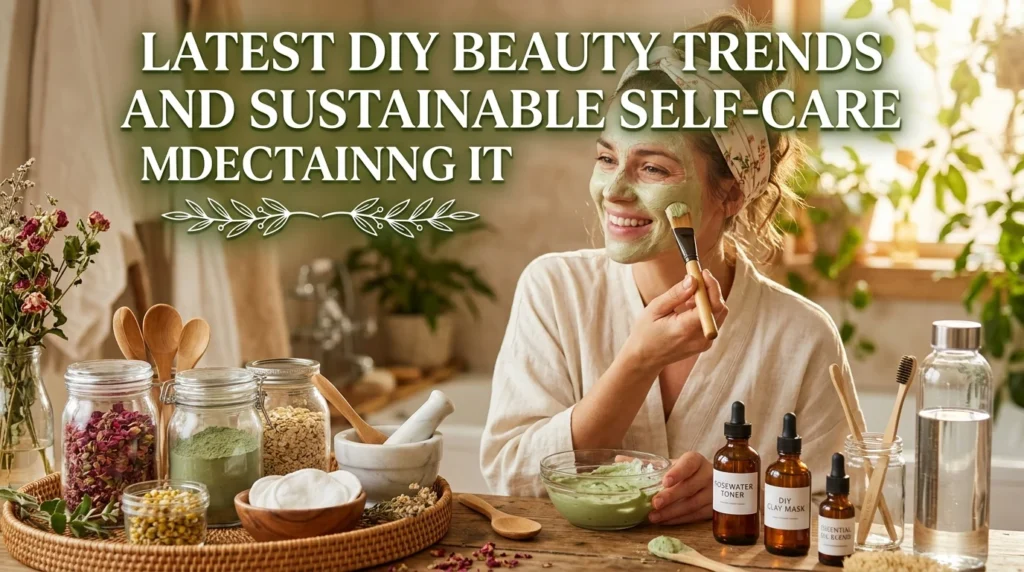
DIY beauty continues to evolve as consumers become more interested in ingredient transparency, minimal routines, sustainability, and personalized self-care.
One noticeable direction is the move toward simpler beauty routines. Instead of collecting dozens of products, many people are choosing fewer products that meet specific needs.
Refillable packaging, reusable tools, low-waste beauty rituals, and multifunctional ingredients also fit the broader sustainability conversation.
Popular DIY-inspired trends
- Minimal-ingredient skincare.
- Homemade body scrubs.
- Oat-based soothing treatments.
- Hair oiling rituals.
- Bath and wellness recipes.
- Ingredient-focused beauty education.
- Low-waste beauty routines.
- Personalized self-care rituals.
Sustainability warning
DIY does not automatically mean environmentally friendly.
Buying ten specialty ingredients that expire after one use may create more waste than purchasing one well-formulated product.
Sustainable beauty means using what you need, storing products properly, reducing waste, and avoiding unnecessary purchases.
A smarter modern approach
Use DIY beauty for creativity and simple treatments while relying on professionally formulated products where safety, stability, testing, or precise concentrations matter.
That balanced approach can give you the best of both worlds.
Conclusion
DIY beauty products can turn ordinary self-care into a thoughtful and enjoyable ritual. Simple homemade treatments may help you explore ingredients, reduce unnecessary spending, and personalize parts of your beauty routine.
The key is moderation. Natural does not automatically mean safe, and a viral recipe is not the same as a scientifically tested cosmetic formula.
Start with simple ingredients, make small batches, maintain excellent hygiene, patch test unfamiliar preparations, and avoid risky kitchen experiments. Keep sunscreen and complex treatment products professionally formulated whenever possible.
Healthy beauty is not about doing everything yourself. It is about understanding your skin, respecting its barrier, choosing ingredients carefully, and building habits that support confidence and wellness over time.
If you experience persistent irritation, severe acne, unexplained rashes, significant hair loss, or another ongoing skin concern, consult a qualified dermatologist rather than relying on DIY treatments alone.
FAQs
Are DIY beauty products safe for everyone?
No. Homemade beauty products can cause irritation or allergic reactions. Use simple ingredients, patch test first, and avoid risky recipes.
What is the easiest DIY beauty product for beginners?
A simple oatmeal-and-water mask or a basic body scrub can be a beginner-friendly option. Keep the recipe simple and prepare only a small amount.
Can I make DIY moisturizer at home?
Simple oil-based treatments are easier for beginners. Homemade water-based moisturizers are more difficult because they require appropriate preservation and formulation.
Can I use lemon juice on my face?
It is best to avoid applying lemon or lime juice directly to facial skin. Citrus can cause irritation and may contribute to sunlight-related skin reactions.
Can DIY beauty products replace sunscreen?
No. Homemade sunscreen should not replace a properly tested broad-spectrum sunscreen. Reliable sun protection requires appropriate testing and formulation.
How long do homemade skincare products last?
It depends on the ingredients and formulation. Water-containing homemade products can spoil quickly, so beginners should make small amounts and avoid long-term storage.
How often should I use DIY face masks?
For many simple masks, occasional use is enough. Once weekly can be a reasonable starting point, but sensitive skin may require less frequent treatments.
Are essential oils safe for DIY skincare?
Essential oils can cause irritation or allergic reactions, especially when used at inappropriate concentrations. Beginners should be cautious and avoid applying undiluted essential oils to skin.
What DIY beauty ingredients are good for dry skin?
Ingredients such as finely ground oats and suitable plant oils may help skin feel softer and more comfortable. A professionally formulated moisturizer is often more reliable for regular barrier care.